
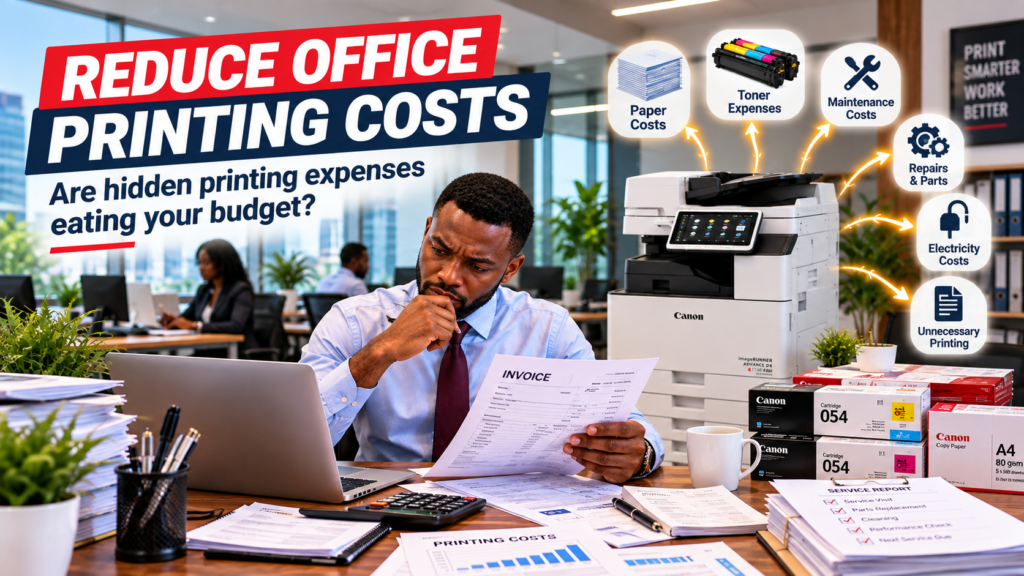
Printing is one of those business expenses that can easily go unnoticed. You buy paper, replace toner, service a copier and continue printing. Because these costs are often spread across different departments, suppliers and invoices, it can be difficult to see how much your organisation is actually spending. However, when printing volumes are high and there is little control over usage, these small expenses can quickly become a significant monthly cost.
The problem becomes bigger when businesses operate multiple printers, experience frequent breakdowns, print unnecessary documents, use colour printing for routine work or have no clear idea of their printing cost per page. Add paper waste, toner consumption, repairs, maintenance and employee time, and the real cost of printing can be considerably higher than what appears on the surface. These are some of the hidden printing costs that businesses often overlook.
The good news is that organisations can take practical steps to reduce office printing costs without stopping essential printing. By understanding where the money is going, measuring print volumes, controlling unnecessary printing, reviewing equipment and considering managed print services, businesses can gain better visibility and control over their printing environment. In this guide, we will examine the real costs behind office printing, identify common sources of waste and show you practical steps to manage your printing expenses more effectively.
Many businesses look at printing as a simple expense: buy paper, buy toner, repair the printer and keep printing. However, the real cost is often spread across several departments and suppliers. That makes it difficult to see the full amount the organisation is spending.
If your organisation wants to reduce office printing costs, the first step is understanding where the money is going. Paper is only one part of the equation. Toner, electricity, maintenance, replacement parts, downtime and unnecessary printing can all contribute.
The problem: printing happens across departments without a central view of usage and cost.
Why it matters: small uncontrolled expenses can accumulate into significant monthly and annual spending.
What you will learn: how to identify hidden printing expenses, calculate your actual printing cost and create a practical system for controlling them.
One reason businesses struggle to reduce office printing costs is that printing is rarely managed as one complete business function.
For example, procurement may purchase printers, finance may pay toner invoices, IT may handle network problems and individual departments may arrange repairs. Consequently, nobody sees the complete printing picture.
Xerox similarly identifies decentralised management, scattered acquisitions and hidden fleet expenses as challenges in managing office output environments.
A better approach is to bring the information together:
Once these figures are visible, management can make better decisions.
One of the most useful ways to reduce office printing costs is to understand your actual printing cost per page.
A simple calculation is:
Printing Cost Per Page = Total Printing Costs ÷ Total Pages Printed
However, total printing costs should include more than toner.
Consider:
For instance, if an organisation spends GH₵6,000 in total printing-related costs and produces 30,000 pages, its effective cost is:
GH₵6,000 ÷ 30,000 = GH₵0.20 per page
This figure gives management a useful starting point for measuring performance.
The objective is not necessarily to achieve the lowest theoretical cost. Instead, the goal is to understand what your organisation is actually paying.
Some of the biggest opportunities to reduce office printing costs are found in hidden printing costs rather than obvious purchases.
Imagine an employee prints a 20-page document, notices a formatting mistake and prints it again. Another employee sends a document to a printer but never collects it. Elsewhere, a department keeps an old printer that requires frequent repairs.
Individually, these incidents appear insignificant. Across hundreds or thousands of print jobs, however, they become meaningful.
Common hidden printing costs include:
ENERGY STAR notes that secure printing can help address pages left at printers and recommends duplex printing and appropriate quality settings to reduce unnecessary consumption.
Businesses trying to reduce office printing costs sometimes focus heavily on toner prices while ignoring printer maintenance costs.
An inexpensive printer can become expensive if it frequently requires repairs, replacement parts or technician visits. Similarly, an old machine may consume management time even when its individual repair bills appear manageable.
Therefore, assess every device according to its total operating requirements.
Ask:
Preventive maintenance can also help organisations identify problems before they become major operational disruptions.
Another practical way to reduce office printing costs is to examine whether your organisation has too many printing devices.
Consider an office with 40 employees and 18 printers. At first, having a printer close to every team may appear convenient. Yet each device can create additional toner, maintenance, electricity and support requirements.
A more structured environment may use fewer strategically positioned multifunction devices where appropriate.
Before removing equipment, however, analyse:
The objective is not simply to have fewer printers. It is to create an efficient print fleet that matches actual business needs.
Xerox describes device consolidation as one approach to lowering costs and improving utilisation.
External DoFollow source: Xerox Managed Print Services
If you want to reduce office printing costs, employee printing behaviour deserves attention.
Not every print job is necessary. Some documents are printed for temporary reference, internal review or convenience. Others are printed incorrectly and discarded.
Simple policies can make a difference:
ENERGY STAR recommends printing only when necessary, using double-sided printing and selecting appropriate quality settings.
These measures can reduce paper consumption while also supporting broader sustainability goals.
To reduce office printing costs, management needs to understand print volume.
Suppose a business prints 30,000 pages every month. If unnecessary printing increases volume by just 10%, that represents another 3,000 pages.
Now multiply those additional pages by your effective printing cost per page.
At an illustrative cost of GH₵0.20 per page:
3,000 unnecessary pages × GH₵0.20 = GH₵600
That is GH₵600 in additional monthly printing expenditure under this example.
The actual figure will differ from organisation to organisation. That is why businesses should use their own meter readings, invoices and supply records rather than relying on assumptions.
A clear printing policy can help organisations reduce office printing costs without stopping employees from doing their jobs.
The policy should explain when employees should print, what type of printing requires approval and how sensitive documents should be handled.
For example, an organisation could establish:
| Printing Area | Possible Policy |
|---|---|
| Internal documents | Black and white |
| Draft documents | Lower-quality mode |
| General reports | Double-sided |
| Confidential documents | Secure release |
| Large colour jobs | Central production device |
| Unnecessary printing | Discouraged |
| High-volume printing | Approved device |
The policy should be simple enough for employees to follow. Furthermore, management should measure the results rather than assuming that the policy is working.
Xerox’s print-management solutions include controls for print usage, budgets and user activity.
You cannot consistently reduce office printing costs if you do not know what is happening inside your print environment.
Start by collecting actual information for at least one month. For larger organisations, three months can provide a more useful baseline.
Record:
Then identify unusual patterns.
A printer with extremely low utilisation may be unnecessary. Conversely, another device may be overloaded and require replacement with higher-capacity equipment.
Print analytics can reveal who, what, when and where printing occurs, helping organisations identify improvement opportunities.
For organisations looking to systematically reduce office printing costs, managed print services can provide a structured approach.
Managed Print Services, or MPS, typically combines assessment, device management, monitoring, supplies, service and reporting into a coordinated print environment.
Instead of asking several departments to manage different pieces of printing, the organisation gains greater visibility over the fleet.
Depending on the provider and contract, an MPS programme can include:
HP describes MPS as a combination of hardware, supplies, solutions and services designed to help organisations manage their print infrastructure and lower total printing costs.
Here is an illustrative example, not a claim about a particular company’s actual expenditure.
Imagine a 50-employee organisation printing approximately 30,000 pages every month. Its management believes printing costs are mainly paper and toner.
After an internal review, the company discovers additional expenses involving maintenance, emergency supplies, inefficient devices and unnecessary reprints.
Suppose the organisation calculates an effective printing cost of GH₵0.20 per page:
30,000 × GH₵0.20 = GH₵6,000 monthly
If better controls reduce unnecessary volume by 10%, the organisation would eliminate approximately 3,000 pages.
At the same illustrative cost:
3,000 × GH₵0.20 = GH₵600
The lesson is important: the company did not necessarily need to stop printing. It needed to understand and manage its printing environment.
To reduce office printing costs, start with a practical process rather than changing everything at once.
List every printer, copier and multifunction device.
Collect monthly meter readings and print volumes.
Include paper, toner, maintenance, parts, electricity and service costs.
Divide total costs by total pages.
Look for unnecessary colour printing, duplicate documents and abandoned print jobs.
Identify devices that are underused, overloaded or expensive to maintain.
Set sensible rules for colour, duplex and secure printing.
Compare results against your baseline.
This process creates a repeatable system rather than relying on occasional cost-cutting exercises.
If your organisation is still struggling to reduce office printing costs, external expertise may be useful.
This becomes particularly relevant when the business has multiple branches, high print volumes, numerous devices or frequent service problems.
A professional print partner can help assess the environment and recommend appropriate equipment, servicing, leasing, supplies and management arrangements.
For example, Printware provides printing and photocopier sales, leasing and service solutions across Ghana, with regional sales and service coverage and dedicated account management.
For businesses considering leasing, Printware also presents options involving structured monthly charges and other printing arrangements. Exact terms should be confirmed for the specific solution and contract.
Trying to reduce office printing costs should not mean simply telling employees to print less.
The bigger opportunity is to understand the entire printing environment: equipment, usage, toner, paper, maintenance, downtime, employee behaviour and purchasing decisions.
Start with a simple audit. Calculate your printing cost per page. Identify hidden printing costs. Review your printer maintenance costs. Then determine whether better print policies, fleet optimisation, leasing or managed print services could improve your situation.
The important question is not:
“How much did we spend on toner this month?”
It is:
“How much does printing really cost our organisation?”
Once you know the answer, you can start managing it.
Printware helps businesses and organisations across Ghana with photocopier sales, leasing, servicing and printing solutions.
📞 030 285 5300 / 027 033 7331 / 057 767 9988
📧 sales@printwaregroup.com
🌐 www.printwaregroup.com
Talk to Printware about copier leasing, sales, servicing and document solutions designed to keep your business moving.
Continue reading more insights from Printware.

Printing may seem like a small part of running a business, but when dozens or hundreds of employees print every........
Signup our newsletter to get update information, news & insight